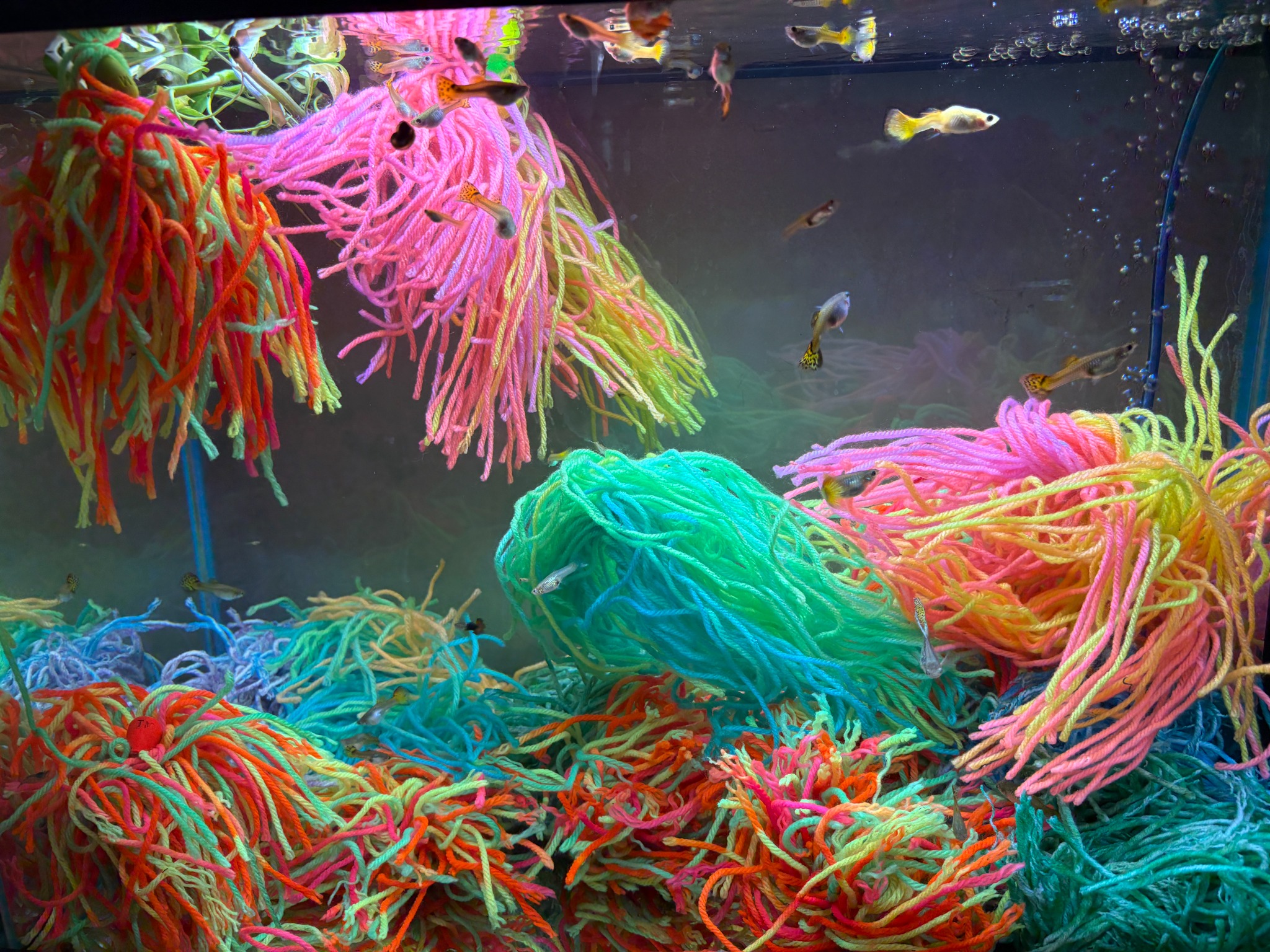
What is a fish spawning mop?
A spawning mop is a bundle of soft strands that offers structure like fine aquatic plant roots. AquaNest mop strands are made from 100% acrylic fibers. Suitable egg layers deposit eggs among the strands; you can move the egg-bearing mop to a prepared hatching tank. Livebearers give birth to live fry, which use grouped mops as cover.
Why use a fish spawning mop?
Spawning mops add colorful, reusable cover. Group several for livebearer fry to hide among, or let suitable egg layers deposit eggs on the strands and move the egg-bearing mop to a prepared hatching tank. Cover can reduce exposure to adults, but it does not guarantee survival. Empty mops are easy to lift out, rinse and reuse.
Which fish can use a fish spawning mop?
Match the use to your fish. Suitable rainbowfish, medaka and mop-spawning killifish can use mops for eggs. Guppies, endlers, platies and mollies use them as fry cover. Shrimp use strands for grazing and shelter. Check behavior and the compatibility guidance below; not every species spawns on mops.
Fish and shrimp kept with mops for shelter or breeding, depending on the species
- Angelfish
- Bettas
- Danios (Zebra, Pearl, Leopard)
- Discus
- Ember Tetras
- Endlers
- Glowlight Tetras
- Goldfish
- Guppies
- Koi (choose spacing and coverage appropriate to their size; see our koi guide)
- Killifish
- Mollies
- Neon Tetras
- Paradise Fish
- Platies
- Rainbowfish
- Rasboras (Harlequin, Chili, Galaxy, etc.)
- Ricefish (Medaka)
- Shrimp, including common small freshwater aquarium shrimp such as Amano shrimp, Bamboo shrimp, Bee shrimp (including Taiwan Bees like Blue Bolt and Panda), Cherry and other Neocaridina shrimp (Red, Blue, Yellow, Rili, Snowball), Crystal shrimp, Ghost shrimp, Sulawesi shrimp, and Tiger shrimp
- Swordtails
- White Cloud Mountain Minnows
- …Most soft finned fish.
Avoid Use With the Following Fish:
Any fish with locking dorsal or pectoral fin spines
Bottom-dwelling species that wedge into décor
Corydoras Catfish NO
Crayfish NO
Freshwater Puffers (Fahaka, Figure-8, Green Spotted) NO
Freshwater Stingrays NO
Large Spiny Cichlids (Oscars, Jack Dempsey, Green Terror, Convicts) NO
Loaches (Clown, Yo-Yo, Skunk, Hillstream) NO
Plecos (Bristlenose, Common, Sailfin, Royal) NO
Raphael Catfish (Striped, Spotted) NO
Spiny Eels (Mastacembelus species) NO
Synodontis Catfish NO
How do I use a fish spawning mop?
Hold from the center and rinse well before placing in your aquarium. Our spawning mops come as either floating or non floating. We attach foam to the middle so the mop floats near the surface, or with out foam it sinks naturally or tie on a suction cup (included) to help position them where you want. For livebearer fry, group several mops into dense cover and leave the cover in the tank; keep room for circulation. For egg collection, rotate a spare mop into the breeders’ tank. When eggs are laid on the strands, gently move the mop and attached eggs to a separate rearing container.
Why is my non floating mop floating?
Before first use, rinse the empty mop and gently squeeze it underwater to release trapped air. Swirl lightly and allow the strands time to wet and settle. Do not squeeze a mop containing eggs or animals.
How do I clean and reuse my mop?
Washable and reusable: check for eggs, fry and shrimp first. Gently swish an empty mop in removed aquarium water for routine debris removal; do not use soap. Leave an egg-bearing mop undisturbed during incubation. For more detailed cleaning instructions, see our guide on how to clean fish spawning mops.
Where are your mops made?
Our spawning mops are handcrafted in Michigan, USA, using aquarium‑safe materials.
When will my mop ship?
In-stock orders are prepared within 1–3 business days and shipped with tracking via USPS Ground Advantage. Allow an estimated 3–8 business days from order to delivery, including preparation and carrier transit. Delivery dates are estimates, not guarantees. US shipping is $4.99 per order, or free for orders of $45 or more. Backordered items are handmade once materials arrive and may require additional time.
Do you ship outside the USA?
Online checkout currently accepts US delivery addresses. For Canada, email sales@spawnmops.com with your quantity and postal code for a shipping quote before ordering. Wholesale orders start at 24 mops. See this page for bulk orders.
How long will my mop last?
Mops are reusable, and their useful life depends on handling, cleaning and how your fish interact with them. Check for wear each time you clean; replace a damaged or tangled mop.
Inspect the strands and center tie regularly. Replace a mop if it develops loose fibers, damage or tangles that cannot be safely resolved.
For more questions or to purchase fish spawning mops, contact us at sales@spawnmops.com and explore our history of fish spawning mops to learn more.