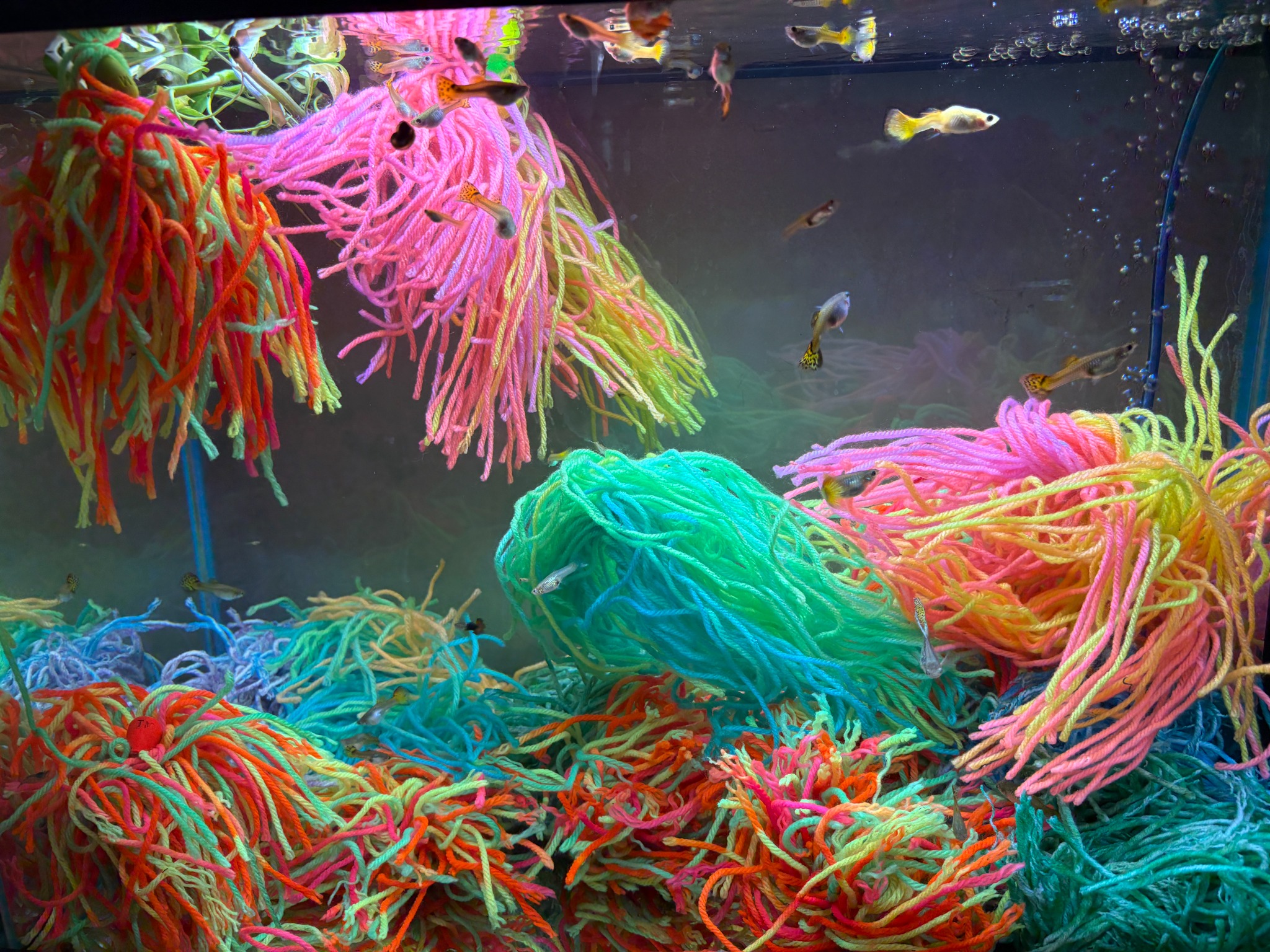
Spawning mops are best known as tools for breeding egg-laying fish, but in modern aquariums their role has expanded far beyond egg collection. Today, spawning mops are widely used for fry protection, enrichment, and habitat structure, making them valuable even in tanks where active breeding is not the primary goal.
While the design dates back more than a century, how aquarists use spawning mops has evolved with a deeper understanding of fish behavior and fry survival. With modern aquarium safe materials like acrylic, mops are now safer and easier to clean then they have ever been.
Why Fibrous Fish Spawning Mops Work
From the earliest breeding manuals to modern aquariums, the principle remains the same:
fine fibers mimic aquatic plant roots.
These fibers provide:
- Surface area for eggs to adhere
- Physical and visual cover for smaller fish and fry that reduces stress
- Gentle structure that fish instinctively trust
What early breeders used to protect eggs, modern aquarists now use to protect newly hatched fry and small juvenile fish.
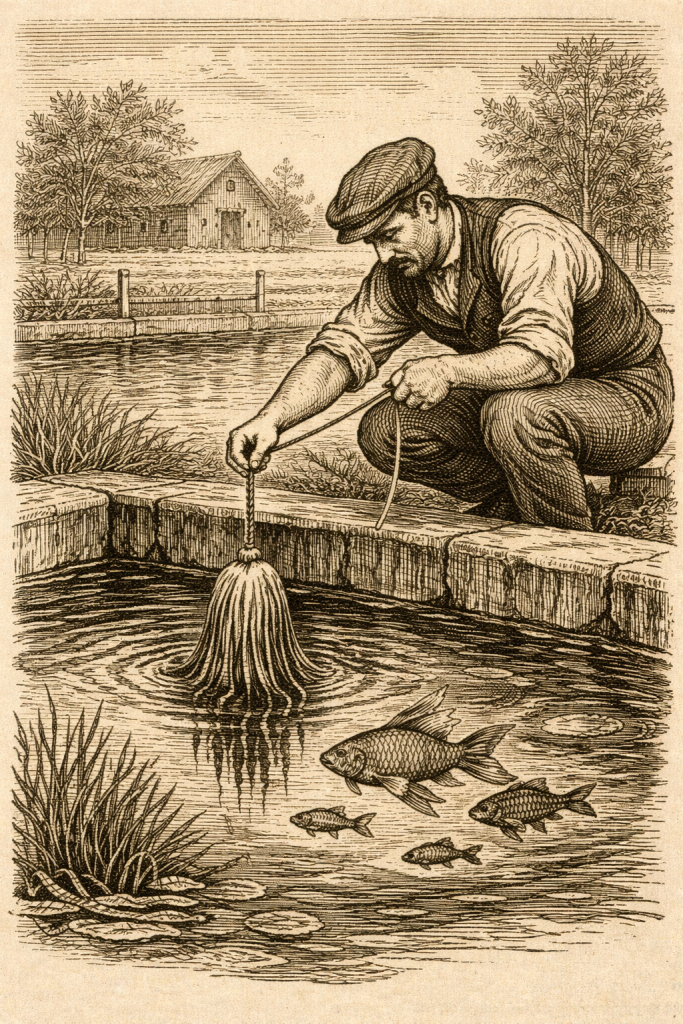
Historical Roots: Egg Collection for Fish Spawning Mops
EARLY PUBLISHED REFERENCES TO WOOL SPAWNING MOPS (PRE-1940)
The use of wool or yarn as an artificial spawning medium for aquarium fish is not a modern invention. Published aquarium literature from the early 20th century clearly documents the intentional use of wool yarn bundles, functionally identical to modern spawning mops, to collect adhesive fish eggs and replicate fine rooted aquatic plants.
Chronological documentation is as follows:
- AQUATIC LIFE MAGAZINE (UNITED STATES, 1920)
One of the earliest known English-language references appears in Aquatic Life magazine, where aquarists describe replacing plants with loose masses of wool yarn for egg scattering fish.
Quoted text:
“Egg scattering fishes which in nature deposit their eggs upon fine plants may be induced to spawn readily in the aquarium by providing a loose mass of woolen yarn threads, to which the adhesive eggs will cling and from which they may be easily removed.”
Citation:
Bausman, J. E. (ed.). Aquatic Life, Vol. 5, No. 6. June 1920, United States, pp. 127–128.
- KOSMOS: HANDWEISER FÜR NATURFREUNDE (GERMANY, 1934)
German aquarium literature independently documents the same practice. In a breeding report, wool threads are explicitly used as an artificial spawning substrate.
Original German text:
„Ein Büschel dunkler Wollfäden wurde ins Zuchtbecken eingebracht, worin die Fische ihre Eier ablegten, ähnlich wie in feinfiedrigen Wasserpflanzen.“
English translation:
“A tuft of dark wool threads was introduced into the breeding tank, in which the fish deposited their eggs, in the same manner as they would among fine-leaved aquatic plants.”
Citation:
Förstel, A. “Zucht von Kampffischen.” Kosmos: Handweiser für Naturfreunde, Vol. 30, No. 8, 1934, Stuttgart, Germany, p. 352.
- WILLIAM T. INNES – EXOTIC AQUARIUM FISHES (UNITED STATES, 1935)
William T. Innes, whose work became the foundational reference for modern aquarium keeping, explicitly recommends wool as a spawning medium.
Quoted text:
“A bunch of dark worsted wool suspended in the aquarium will often serve better than plants for egg-scattering fishes, the adhesive eggs clinging firmly to the fibers.”
Citation:
Innes, William T. Exotic Aquarium Fishes. 1st edition. Philadelphia: Innes Publishing Company, 1935, p. 242.
- WATER LIFE MAGAZINE (UNITED KINGDOM, 1938)
By the late 1930s, the practice was well established in British aquarium literature, with detailed instructions for constructing wool spawning mops.
Quoted text:
“Lengths of untwisted wool yarn tied together to form a floating mop provide an excellent spawning medium; fish will spawn in the wool as readily as in pondweed, the eggs adhering to the woolen strands.”
Citation:
Water Life magazine, January 1938 issue. London, United Kingdom, p. 15.
FORMAL CONCLUSION
Published aquarium literature from at least 1920 onward clearly establishes wool yarn bundles—functionally identical to modern spawning mops—as a recognized, intentional, and effective tool for fish breeding. These sources demonstrate that wool spawning mops are among the earliest examples of man-made aquarium décor designed specifically for reproductive success.
The Modern Era: Fish Spawning Mops as Fry Shelters
In contemporary aquariums, spawning mops are widely used as fry protection structures, even in tanks where no intentional breeding is planned.
Newly hatched fry instinctively move into the numerous fibers, where:
- Larger fish cannot easily follow
- Water circulation remains gentle
- Microorganisms and biofilm develop naturally
This makes spawning mops especially valuable in:
- Community tanks
- Livebearer tanks
- Shrimp and fry grow-out systems
Aqua Fish Mops allow fry to self-hide, dramatically increasing survival rates.
Safe Habitat for Fry and Juveniles: Fish Spawning Mops
Our spawning mops are particularly effective for:
- Guppy fry
- Molly and platy fry
- Goldfish fry
- Killifish fry
- Shrimp of all stages, adult, larvae, and juveniles
The soft yarn structure allows fry to move freely without injury, while still providing protection from adult fish.
Adult Fish Compatibility: Why Barbless Fish Are Ideal for Fish Spawning Mops
Spawning mops are best suited for soft-bodied, barbless fish or species with minimal projections.
They work exceptionally well with:
- Guppies
- Mollies
- Platies
- Goldfish
- Koi
- Killifish
Fish without sharp barbs or spines can safely weave through the fibers without risk of entanglement or stress. For these species, spawning mops double as both habitat enrichment and security cover.
Beyond Breeding: Enrichment and Natural Behavior with Fish Spawning Mops
In modern aquariums, spawning mops are no longer limited to breeding setups. Many aquarists use them year-round because fish:
- Actively explore the fibers
- Rest within the strands
- Display reduced stress behaviors
Shrimp and microfauna often graze on biofilm that forms on the yarn, adding another layer of ecosystem benefit.
A Proven Tool, Reimagined for Modern Aquariums: Fish Spawning Mops
The spawning mop has evolved from a specialized breeding tool into a multi-purpose aquarium habitat. Its continued success comes from the same biological principles that made it effective over a century ago—now applied to modern goals like fry survival, stress reduction, and enrichment.
From fry shelter, to egg protection, to habitat enrichment, spawning mops remain one of the quickest and most effective additions an aquarist can make to a tank.
MODERN REFERENCES SUPPORTING THE USE OF ACRYLIC YARN SPAWNING MOPS
(1970s–PRESENT)
Modern aquarium literature, both hobbyist and scientific, clearly documents the widespread and intentional use of acrylic yarn as a spawn and egg-collection medium of choice. Acrylic yarn is favored for its durability, resistance to rot, and consistency in water, making it a preferred material for spawning mops across multiple fish keeping species.
The following sources are presented in chronological order.
1) 1985, American Currents (Killifish Association of America)
Hal Fairfield describes the deliberate use of acrylic yarn to create a floating spawning mop for fish breeding.
Quoted passage:
“In the early spring… I… added a floating spawning mop (made from a bottle cork and acrylic yarn) to the aquarium. This mop provided a spawning medium and was long enough to reach the bottom of the aquarium.”
Citation:
Fairfield, Hal. “Breeding Fundulus heteroclitus.” American Currents, December 1985.
2) 1993, Copeia (American Society of Ichthyologists and Herpetologists)
A peer-reviewed scientific journal documents the use of acrylic yarn as an artificial spawning substrate in controlled research.
Quoted passage:
“Artificial plants were constructed by tying 100 300 mm long strands of ‘Forest Green’ 4-ply worsted weight acrylic yarn at one end.”
Citation:
Vives, Stephen P. “Choice of spawning substrate in red shiner.” Copeia, 1993(1): 229–232.
3) 2010, Tropical Fish Hobbyist Magazine
One of the most widely read aquarium publications explicitly identifies acrylic yarn bundles as the standard spawning mop material used by experienced breeders.
Quoted passage:
“Spawning mops used by the majority of killie keepers are acrylic yarn bundles.”
Citation:
Grady, Thomas R. “Rivulus: From Boring to Beautiful.” Tropical Fish Hobbyist, June 2010.
4) 2011, Adrian R. Tappin (International Rainbowfish Authority)
A leading authority on rainbowfishes recommends acrylic yarn specifically to prevent material breakdown in water.
Quoted passage:
“Use acrylic yarn to avoid it rotting in water… The acrylic yarn can be wrapped around anything.”
Citation:
Tappin, Adrian R. Rainbowfishes: Their Care and Keeping in Captivity. 2011.
5) 2019, Tropical Fish Hobbyist Magazine
Quoted passage:
“Add several clumps of fine-leaved live plants… or even a pile of acrylic yarn spawning mops.”
Citation:
“Meet the White Clouds.” Tropical Fish Hobbyist, May/June 2019.
Have questions or want to purchase fish spawning mops? Contact us at sales@fishmop.com or visit our guide on How to clean fish spawning mops to learn more.